

Serviceable Available Market
What is the Serviceable Available Market (SAM)?
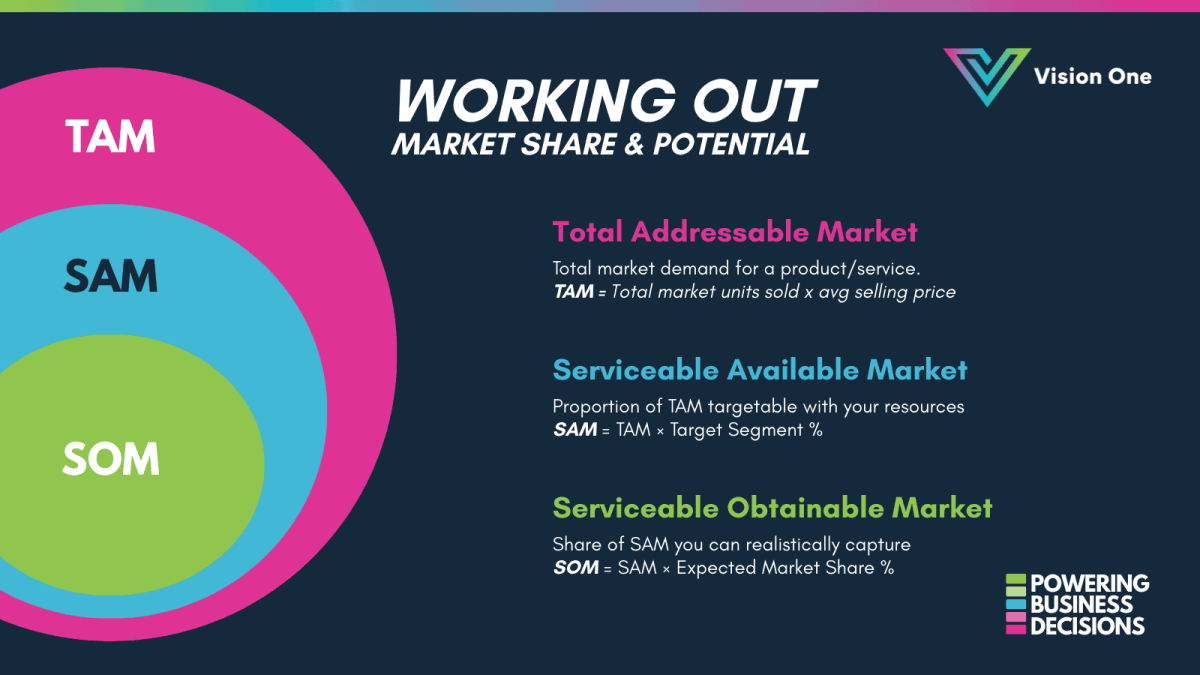
The Served, or Serviceable Available Market (SAM), represents the portion of the Total Addressable Market (TAM) that your business can realistically target, based on factors like geography, customer segments, regulations, and your product’s use case. Think of SAM as the slice of the market that’s relevant to you. While TAM is the big-picture number for the entire universe of demand, SAM narrows it down to the customers you can reach with your business model and resources.
Why is SAM Important for New Product Launches?
When you’re entering a new market and/or launching a new product, calculating the market size is essential and understanding SAM helps you go from theoretical to practical:
- Focus on the right audience
SAM helps marketers avoid spreading resources too thin. It identifies the group of customers you can realistically serve, ensuring messaging and budgets are directed effectively. - Set realistic goals
TAM might suggest a multi-billion-dollar opportunity, but SAM grounds your planning in the part of that market you can actually address. - Build credible business cases
Investors and stakeholders want to see focus. By showing SAM, you demonstrate that you’ve thought through constraints and are targeting a reachable segment.
Why is market research essential to calculating market potential?
Consumer market research is critical for accurately evaluating market potential and size and for calculating SAM and SOM. It identifies market trends, demographics, economic shifts, customer buying habits, customer satisfaction and how much they are prepared to pay, along with important information on competition. This information will help to define your target markets and establish a competitive advantage in the marketplace.
How to Calculate SAM
There are three main ways entrepreneurs and marketers can define SAM:
- Geographic Filtering
Narrow TAM by region. If your product only ships within the UK, your SAM excludes the rest of the global market.- Example: TAM = $500bn global market → UK segment = $12bn SAM.
- Customer Segmentation
Refine TAM by focusing on the most relevant customers.- Example: In a global software TAM, your SAM might include only small- and medium-sized businesses in Europe.
- Product/Regulatory Fit
Remove areas of TAM that you cannot serve due to product limitations or regulations.- Example: A healthcare device approved only in the EU cannot count the US market in its SAM.
In Summary
For marketers and entrepreneurs, Serviceable Available Market is where opportunity meets focus. It takes the expansive TAM and narrows it to the customers and regions you can realistically serve with your new product. By calculating SAM, you move one step closer to defining achievable growth, credible forecasts, and a strong go-to-market strategy.
- SAM bridges the gap between vision and reality: It shows how much of the TAM is relevant to your product.
- It sharpens strategy: SAM defines the battlefield where you can win customers.
- Investors care about it: SAM shows they’ve applied discipline, not just ambition.
- It’s a filter, not a limitation: By growing into new regions or segments, your served addressable market can expand.


