
NPS and Customer Willingness to Recommend
Net Promoter Score (NPS)

Net Promoter Score is all about measuring how well your brand is ‘delivering’.
It’s a crucial tool in identifying areas for improvement, understanding your overall business performance and how perceptions of your brand are evolving.
NPS, is often used in Customer Satisfaction Surveys and is one of the 8 metrics that we use to evaluate brand equity and is an integral part of our brand tracking. This particular metric measures customers’ willingness to recommend a company, product or service to a friend. Essentially, it’s a customer loyalty metric.
Initially developed in 2003 by Fred Reichheld, Bain & Co and Satmetrix, to help companies earn customer loyalty and inspire employees, the Net Promoter Score is an important part of consumer research. Research carried out by Nielsen supported the metric, confirming that word of mouth is the most influential element of consumers’ purchasing decisions.
Why is NPS important?
Net Promoter Scores are often great predictors of business growth. If your score is higher than the industry average, it indicates you have a healthy relationship with your customers – you have a base of loyal fans.
How does NPS work?
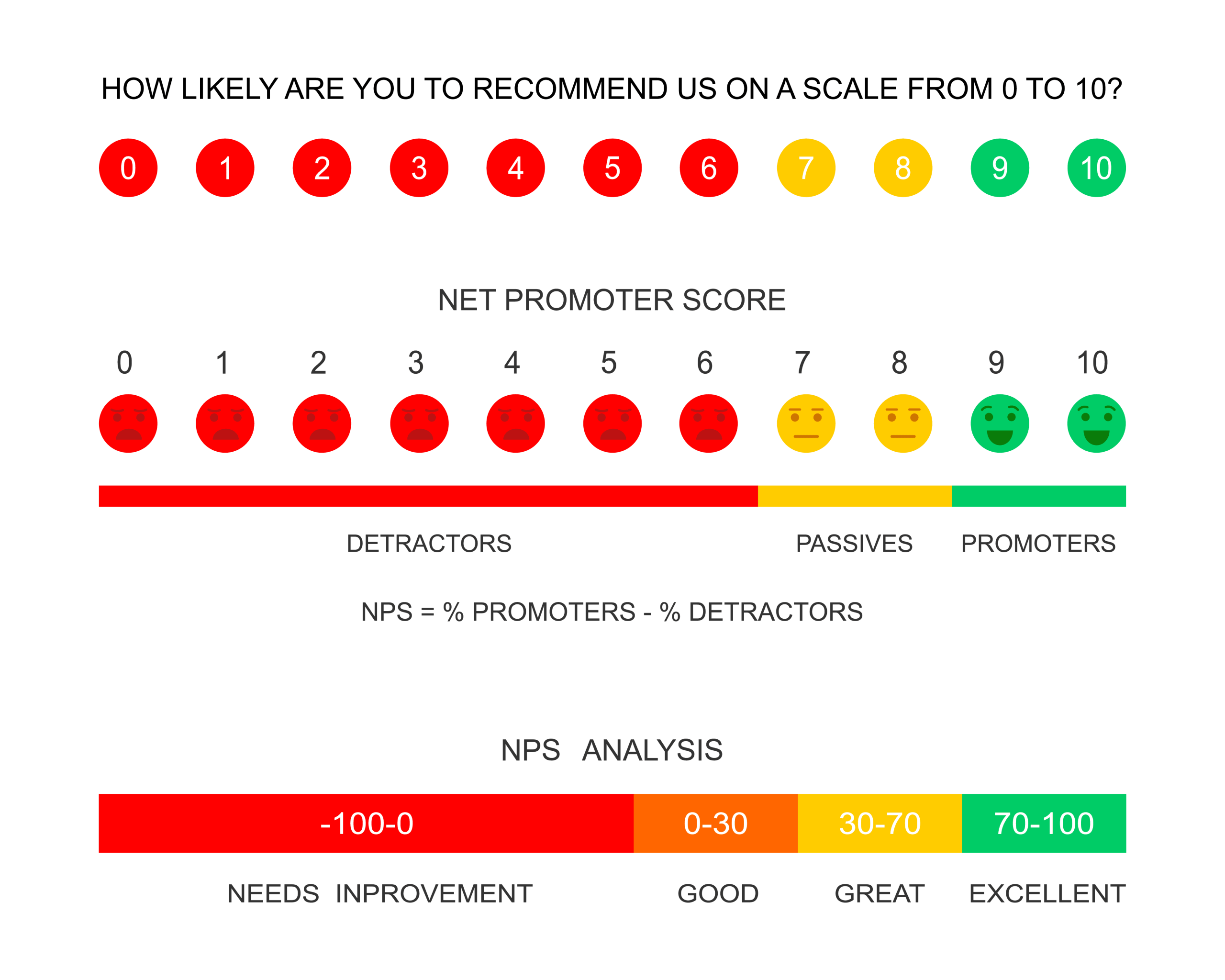
We’ve all heard it a million times before, ‘On a scale of 0 – 10, how likely are you to recommend this product to a friend?’
One seemingly simple question, yet it is often the culmination of a complex series of personal perceptions, opinions, instincts and past experiences. Recommend a product or business to a friend, and you are giving it your own, personal seal of approval – you are effectively a brand ambassador, a promoter.
For businesses, it’s a hugely important indicator of how they are perceived by those that matter the most – consumers.

Understanding Promoters, Passives & Detractors
Net Promoter Score categorises your customers into 1 of 3 groups: Promoters, Passives and Detractors. The higher your NPS score, the more promoters your brand has.
It’s easy to focus on the customers who seem to be the ‘biggest fans’(e.g. the Promoters). But it’s also important to pay close attention to customers who may be ‘Passive’ or ‘Detractors’.
Passives are on the cusp of becoming promoters, so it is worth exploring how to enhance their experience and perceptions to improve future scores. Engage with your customers – ask them questions like “what could we do better?” Increasing your number of promoters will boost your brand health.
Detractors also require close attention. If someone is actively dissuading others from using your brand, they could sway a passive or convert a promoter.
Benefits of Net Promoter Score
- NPS is one of the easiest and cheapest ways to track your brand’s performance.
- You can track your scores over time, making it a great benchmarking tool.
- NPS focuses on customers’ opinions. It encourages consumer engagement and helps your brand develop a relationship with consumers.
- By following up with probing questions within your NPS survey, you can explore ‘why’ consumers have given their score.
Drawbacks of Net Promoter Score
While NPS is a long-standing, valued metric, it isn’t always seen as the best way to measure customer loyalty. This is because, in recent years, new tools have been introduced that provide a better indication of success. For example, BrandVision has a metric called ‘Momentum’, which could be argued to be a better way to view a brand’s market position and its potential to beat competitors.
Alternative metrics to NPS
Running brand tracking surveys over time will allow you to spot trends and take action more quickly. But you’ll need to measure more than brand metrics if you want truly actionable research, so welcome to BrandVision.
Tab Contents


Welcome to BrandVision
Metrics to Turbo Charge any Brand Strategy
BrandVision is our flexible brand evaluation system that can be customised to your needs. From self-serve to fully managed, BrandVision offers tracking for brands of all shapes and sizes.


Brand Momentum
Discover the power of Brand Velocity.
Brand Velocity is part of Brand Momentum theory and refers to the growth potential for your brand and its likely future trajectory. Velocity measures the extent to which your brand is seen to be growing or declining.
Brand Momentum is a KPI driven by your marketing investment, product availability, brand image and your brand proposition and positioning.
Brand Momentum is a better indicator of growth than virtually any other consumer metric. Its role is far more important than the highly regarded Net Promoter Score because it is a better predictor of growth and growth potential than any other brand metric.

Brand Magnetism
Awareness alone is pointless if your brand doesn’t possess Brand Magnetism.
Part of the Brand Funnel, Magnetism refers to the attraction your brand has with the target market.
There are two aspects to brand Magnetism. Firstly, the strength of the brand’s appeal and interest. Secondly, it is about the segments and groups interested in the brand. Understanding who is and isn’t interested in your brand is the first step in creating a strong marketing and brand strategy.
Brand Magnetism is the holy grail for many brands, as it is often associated with some of the best and most iconic brands in history.

Brand Fame
What is Brand Fame?
Brand Fame (also known as brand leadership) is one of the key metrics that indicate whether or not your brand has a USP and is seen by consumers as a ‘Leader’, ‘Different’ or ‘Characterless’.
There are two very important aspects to Brand Fame: Uniqueness & Leadership. Brands that lack either of these attributes tend to struggle, with little to set them apart from competitors.
A great example of this is people’s desire to own the Apple brand. The high levels of Fame (Distinctiveness and Leadership) correlate strongly with Brand Love and Consumer Loyalty, which have ultimately helped drive Apple’s dominant position in the market.

Brand Love
The Power of Love
The concept of Love in brand relationships has been receiving immense and escalating attention. It is considered by many experts as the essential ingredient for capitalising in today’s new order.
Brand Love underpins the consumer-brand relationship. It’s not an emotional or fluffy metric, but rather the holy trinity of brand metrics, combining three powerful metrics: Relevance, Need, and Trust.
Evaluation of brand tracking data has taught us, time and time again, that Relevance is arguably the most important metric of all – and is highly correlated with consumer behaviour.

Net Promoter Score
The Recommended Metric
Net Promoter Score was initially developed in 2003 by Bain & Co to help companies earn customer loyalty and inspire employees.
NPS is an important part of consumer research for many companies, as it is a measure used to gauge customer loyalty, satisfaction, and enthusiasm for a company
Further research by Nielsen has supported the metric, confirming that word of mouth is the most influential factor in consumers’ purchasing decisions.

Awareness & Mindshare
The Battle for the Mind
Many marketers believe Brand Awareness is a single metric – in truth, it’s a lot more complex than that! As experts in brand awareness measurement, we’d like to explain why.
Behavioural Economics has shown the importance of Availability Bias and that winning customers’ choices means being front of mind. Brand Awareness metrics include: Prompted Brand Awareness, Brand Recognition and Brand Recall. Together, we call it Mindshare.

Brand Health
8 Secrets to a Healthy Brand
- The 8 Essential brand image metrics are:
2. Ethical – Are you seen to be doing the right things?
3. Brand Identity -Does your Brand identity have Clarity?
4. Brand Noise – Is your brand grabbing people’s Attention?
5. Newsworthy – Is your brand worth talking about?
6. Outstanding – Do you offer exceptional Quality or Value?
7. Variety – Is your brand flexible and has multiple uses or benefits?
8. Accessible – Is your brand Readily Available and Convenient?
On Trend – Is your brand Topical & Current?

Research Case Studies
A range of our market research case studies
Recent Case Studies


Latest Client Testimonials
Casio Europe GmbH
From the get-go, Vision One were responsive, easy to work with, and tuned in to what we needed. They were competitively priced (always a win!) but what really stood out was the quality of the insights they delivered – the findings were genuinely useful and helped shape our go-to-market strategy in a meaningful way.

Keolis Group (Public Transport)
Thank you for all the work you have done on this project, it was a really interesting report with some insights that I think will add fantastic value to the bid. It’s been great working with you

Wolters Kluwer (Accountancy)
It has been a pleasure to work with the team at Vision One. It has been a very efficient process and the outputs look amazing, so Thank You!

BASIS Technologies (Software)
This was one of the most successful engagements I have had with a research company in my career

Midea UK (Electrical Appliances)
We also loved working with all the team and we hope to work again together soon

Power X (EV Charging)
We appreciate the great work your team has done, and it really helped us understand EV users in the UK

Citrosuco (Juice)
Vision One assisted us with great agility and quality.

Q&A Vision One’s brand research solutions

Brand market research specifically examines how customers perceive, experience, and connect with a particular brand and its competitors. It’s focused on brand equity, positioning, awareness, loyalty, and emotional resonance.
Brand research companies typically answer questions like: How many people are aware of my brand? What does our brand stand for in customers’ minds? How do we compare to competitors on brand attributes? What drives brand preference and loyalty? How strong is our brand awareness? Which brands to watch out for and have momentum.
Branding market research dives deep into the intangible assets that differentiate one company from another beyond product features and pricing. It measures brand health through metrics like Net Promoter Score (NPS), brand recall, consideration rates, and emotional associations.
We deliver a comprehensive suite of market research solutions designed to drive strategic growth. Our top market research company services include
- Advertising research and Ad testing
- Brand research (identity and brand equity)
- Brand tracking studies
- Business-to-business research
- Customer satisfaction and CX
- Ethnography and observation
- Idea generation and Co-creation
- International & global research
- Market segmentation and personas
- Messaging and Copy testing
- Online research and online surveys
- Pricing Research
- Proposition and Concept testing
- NPD and Product research
- Research training & Consultancy
- Shopper insights and Retail research
- Usage & Attitude surveys
We combine qualitative insight, workshops, and strategic analysis to uncover the core value your brand offers customers. Through techniques such as focus groups, stakeholder interviews, and competitor mapping, we help identify the positioning that will resonate most strongly with your audience and set you apart from competitors.
Effective brand strategy must be built on real customer insight. Our research helps businesses understand how customers perceive the category, what drives choice, and where opportunities exist for differentiation. This ensures your brand strategy is rooted in evidence rather than assumptions.
Kantar
Known for brand equity frameworks such as Meaningful, Different and Salient.
System1 Group
Focuses on emotional response and System 1 advertising effectiveness.
Vision One
Know for BrandVision and its brand wheel and the 8 brand equity metrics (including Brand Momentum).
Vision One offers extensive brand marketing research solutions, spanning qualitative and quantitative methods. Key benefits include:
- Pioneering techniques to uncover new insights and a deeper understanding of customers
- Latest advanced technology for enhanced data analysis and coding
- MRS Company Partners for the highest ethical standards of research
Here’s our top 5 resources for brands:
WARC and Institute of Practitioners in Advertising (IPA) offer excellent range of case studies, research and insights into advertiing and marketing effectiveness
If you’re passionate about the history of brands – why not checkout the museum of brands.

NEEDS SOME HELP?
To us, the Net Promoter Scores are a part of the bigger picture. That’s why we developed our forward-thinking Brand Equity Wheel evaluation tool – assessing every aspect of your brand’s health, including needs, mindshare, value, fame, emotion (and Net Promoter Score). It’s a key part of our market-leading strategic brand-tracking service, BrandVision. The result? A final metric score that can be used strategically to drive sales, market share and growth.
Contact Us
We are quick, responsive, and above all, our research is customised precisely to your needs, ensuring you get exactly what you need every time.
Email us at mail@visionone.co.uk
Complete the enquiry form.
Or book a meeting below.
Powering Business Decisions